
Purchasing an RV could be among the most expensive investments you ever make in your life. As a result, to keep the vehicle in a good shape for as long as possible must be one of your top priorities. When it comes to maintaining RV fiberglass surfaces, waxing is a great method to utilize given its effectiveness and ease of use. But what if you don’t know anything about wax or how to get a suitable one then this article is for you. You can find out the benefits of waxing, the way it works along detailed buyer’s guide to help you to choose the best RV wax for fiberglass among popular products available on the market.
There are a wide range of wax brands available for purchase that could make you feel lost and clueless. People’s preferences vary a lot from one to another so the best product to someone might not work the same for you. This is why it’s essential for you to fully grasp the character of a fiberglass wax in order to make a wise decision. Should you proceed to buy a random product without proper consideration, you may lose a lot of money for nothing. So take your time and think everything through before you head to the counter.
Contents
Top 8 Best RV Wax For Fiberglass on the Market
| Best RV Wash and Wax | Weight | Size | Dimensions | Price | Review |
|---|---|---|---|---|---|
| Meguiar's M5032 Marine | 2 pounds | 32 oz. | 2.1 x 4.5 x 9 | $$$ | ***** |
| Gel Coat Labs Marine & Boat | 1.15 pounds | 16 fl. ounce | 7.7 x 2.7 x 1.7 | $$$ | ***** |
| Marine 31 | 1.1 pounds | 16 oz. | 2 x 4 x 8 | $$$$ | **** |
| Meguiar's M6332 - Editor's Choice | 2.39 pounds | 32 oz. | 3.7 x 2.7 x 8.9 | $$$$ | ***** |
| Meguiar's M5616 Marine | 1 pounds | 16 oz. | 8 x 2 x 9.5 | $$ | *** |
| Gel-Gloss RV - Editor's Choice | 4 pounds | 128 oz. | 8.9 x 7.8 x 4.2 | $$$$ | *** |
| Meguiar's M4965 Marine | 4.2 pounds | 3 x 16 oz. | 12 x 12 x 9.2 | $$$$ | *** |
| Meguiar's M5916 Marine | 1.2 pounds | 16 oz. | 1.5 x 3.8 x 10.2 | $ | *** |
Now, let’s take a closer look at the today’s topic of discussion we have on our hands, we will be looking at the best RV wax for fiberglass that are being widely sold on the market. The reason we’ve made this list is because the market is now saturated with many RV care products such as wax, washing gel and liquid from different brands. While it may seem a piece of cake to choose the right one with experienced consumers, for those who don’t have enough knowledge about these kinds of product, it’s a truly confusing situation.
In order to help you to make a better choice and spend your money wisely, we’re here showing you a shortlist of best RV wax for fiberglass that you can easily find and purchase in the market. When it come to each product, we will give you the detailed review with pros and cons so that you can consider to choose the right wax for your beloved RV. Here we go!
1. Meguiar’s M5032 Marine | RV One Step Cleaner Wax

A long-lasting solution to protect your RV fiberglass from the weather, Meguiar’s M5032 is an effective product. A lot of customers agree that Meguiar’s M5032 is one of the best RV wax for fiberglass on the current market. Available in four different sizes, you could keep the vehicle polished and well protected for years to come. It’s greatly appreciated by customers because the wax is capable to cleanse the RV while adding a protective layer as well. Minor scratches or light oxidation can be promptly deal with no matter what type of the vehicle you have. It employs a nonabrasive formula which means the wax is perfectly safe to use on all surfaces.
One weakness of the Meguiar’s M5032 is that it doesn’t do exactly well on extensively worn out surfaces. In such case, the surface is already in a bad condition, the wax can return the original gloss but not more than that. Besides that, everything about this product is positive, its cleaning quality and protection level are sufficient in most of the time. With a reasonable price and ease of application, Meguiar’s M5032 is a great choice if you want to keep the RV look like new in the foreseeable future.
Pros
- Convenient to apply
- Restore the color and the gloss
- Non abrasive
- Work on boat and RV
Cons
- Barely adequate if the fiberglass damage is at an advanced state.
- Should not be used if the temperature is high
- May leave residue
2. Gel Coat Labs Marine & Boat | Micro Polish and Mirrorlike Shine Sealant
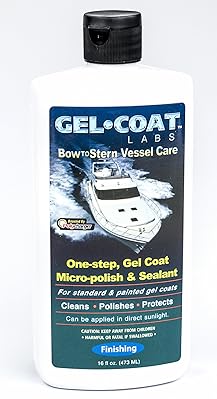

Due to the use of modern polymer technology, the Gel Coat Labs One-Step Micro-Polish and Sealant acts as a durable shield for your RV fiberglass. The gloss and the clarity of the fiberglass can be significantly enhanced with this Gel Coat product. All you have to do is cleanse the roof, let it dry and apply the wax. Use a moderate amount of pressure to spread the wax through the fiberglass surface in a circular fashion. Wait a bit for the wax to bond and get rid of all the residues. Do it correctly and the fiberglass shall have a mirror-like shine without cracks or fades
Gel Coat Labs One-Step Micro-Polish and Sealant is flexible, you can apply it with your own hand or with the help of the machine. For a practical fiberglass wax and a straightforward application, you cannot go wrong with this product. The affordable price tag ensures that it fits everyone wallet. To fiberglass surfaces with a medium level of oxidation, it is an excellent answer.
Pros
- Flexible application
- Effective toward moderate levels of fiberglass oxidation
- Affordable
- Simple to use
Cons
- Take some time to apply it properly
- Possible residue
3. Marine 31 | All in One Gel Coat Polish & Wax
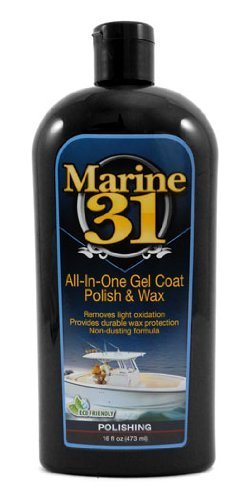
A perfect solution for light oxidation and staining, Marine 31 All in One is an all-around wax everyone can use and quickly become one of the best RV wax for fiberglass that a lot of users are keen on. Combining cleaning agents, micro-abrasives and nourishing oils, it provides the fiberglass with a tough layer of protection. As the name suggests, you won’t have to go through multiple steps to use this product. All you have to do is shake the bottle a bit then the wax is ready to be applied. Pour out a suitable amount of wax into a foam pad and work your way toward a shiny surface. You can do it by hands or a polisher so go with whatever fits you
Oxidation and UV rays exposure are inevitable, they will discolor the fiberglass and compromise the material structural integrity with each passing day. By using the Marine 31 All in One, the shade and quality of the material will be well protected. The process of applying the wax only take a short time and you can travel around with the vehicle worry-free.
Pros
- Restore the appearance of the fiberglass
- Effective against light oxidation
- High cleansing effect
- Cost-effective
Cons
- Doesn’t make the surface very shiny
- The cleaning aspect could be better
4. Meguiar’s M6332 | Flagship Premium Marine Wax – 32 oz
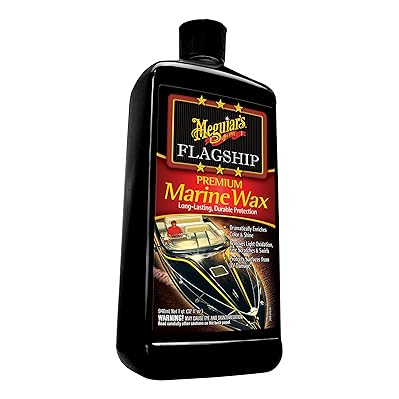
Meguiar’s M6332 is a product highly sought after by peoples that desire deep gloss and extended protection for their fiberglass. From oxidation spots to fine scratches, this wax can make them disappear without a trace after only one application. In addition to that is a durable shield to keep the material from being damaged while enriching its color. It’s easy to handle and apply so you should have little difficulty using it as you wish. Meguiar’s M6332 is not a cleaner wax though its cleansing effect is adequate in the average conditions. This is definitely the best RV wash and wax product you should purchase for your RV.
One great thing about Meguiar’s M6332 is you can employ the wax on decals without disfiguring them. Certain products when applied on decals will make them fade or crinkle, this wax doesn’t have that issue. You may encounter slight residues but they can be removed quite easily with a single wipe.
Pros
- High quality
- Nice shine
- Bring out the surface color
- Last rather long
Cons
- Could make the surface hazy if you don’t cleanse the residue and leftover
- Inconsistent quality between products
5. Meguiar’s M5616 Marine | RV Pure Wax Carnauba Blend – 16 oz
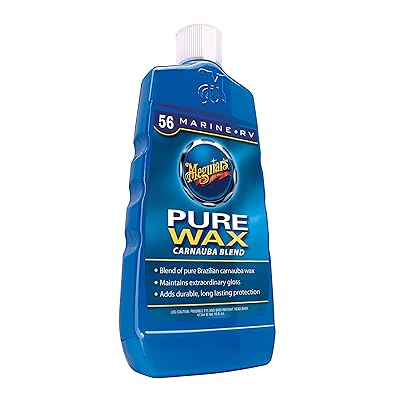
If you want to keep your RV in the ideal state, Meguiar’s M5616 is one of the product you should take a look. It contains pure Carnauba wax and other quality ingredients which allow an impressive performance at a good price. The fiberglass shall be protected with a strong wax protection that also improves the material gloss. With one application, you could expect your RV to look like new for a considerable amount of time. As with other popular products, Meguiar’s M5616 can be apllied either by hand or with a powered tool.
For a glossy finish, Meguiar’s M5616 is what you should use and it will not let you down. Most imperfections exist on the fiberglass surface could be removed with the help of this wax.
Pros
- Tough protection and admirable gloss
- Ideal across all surfaces
- Effective
- Simple to apply
Cons
- Slightly tedious to remove when needed
- Doesn’t shine a lot
6. Gel-Gloss RV Wash and Wax – 128 oz
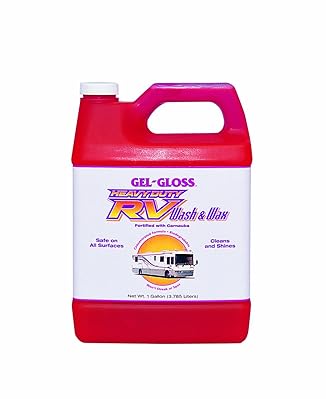
The list of best RV wax for fiberglass could not finish if we do not mention Gel-Gloss. Plenty of wax to go around at a reasonable price tag, Gel-Gloss RV Wash and Wax is an efficient choice. It cleans, protects and shines the fiberglass surfaces without streaking or water spotting. The wax is completely phosphate free and biodegradable so there is no danger toward your health while using it. It got Carnauba wax in its composition as well to enhance its ability to protect the fiberglass. Decals and pinstrips won’t be damaged by Gel-Gloss RV Wash and Wax which mean you can use it freely on the RV exterior. Being reviewed as the best RV wash and wax for the price, this product also works really well for fiberglass!
Pros
- Generous quantity
- Nice scent
- Work amazingly well
- Eliminate stains and streak marks
Cons
- The packaging should be improved
7. Meguiar’s M4965 Marine | RV Fiberglass Restoration System
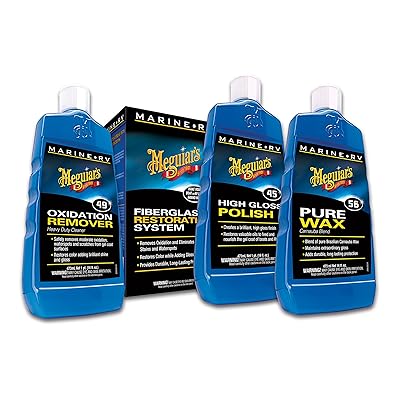
Come in a set of different bottles for distinct purposes, Meguiar’s M4965 will take a good care of the fiberglass surface. Many users who already tried this product agree that Meguiar’s M4965 is one of the best RV wax for fiberglass options. It’s a three-step system with No. 49 for oxidation removal, No. 45 for gloss restoration and No. 56 for long-term protection. This may be a bit complicated compared to one step products but the result is totally worth the effort. When it comes to the decals, Meguiar’s M4965 won’t have an adverse effect on them. But to be on the safe side, apply a small amount of the wax on a portion of the decals first then see how it turns out.
Pros
- Work great
- Make the material shiny
- Hold up well for quite some time
Cons
- Require a lot of time and effort
- A multiple step product
8. Meguiar’s M5916 Marine | RV Quik Wax Clean & Protect – 16 oz
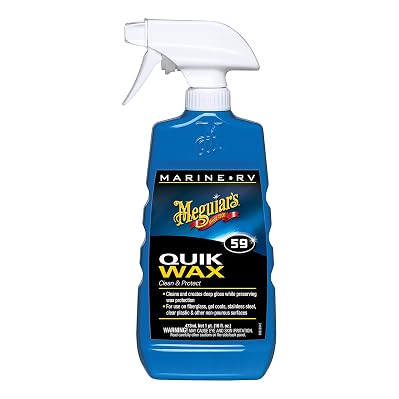
As a spray bottle, Meguiar’s M5916 is exceptionally convenient to use. It cleanses the surface of the fiberglass, forms a deep gloss and applies protection for the material. The wax can be used when the fiberglass is wet or dry and the effect remains the same. Beside fiberglass, Meguiar’s M5916 is also applicable to other materials such as stainless steel, aluminum, plastic and alike. As long as the surface is non-porous, you can use this to good effect.
Pros
- Easy to utilize
- Effective on many surfaces
- Cheap
- No disturbing smell
Cons
- No additional shine
- Barely adequate
Why Should You Wax for RV Fiberglass?
Fiberglass is a common material that can be found on the roof of a recreational vehicle, from entry-level to high-end RVs. Like everything else, exposure to outdoor elements after long days going RVing slowly degrades the fiberglass as time went by. Without regular maintenance, it will become uneven, hazy or chalk which considerably reduces the aesthetic value of the RV. Not to mention a major drop in the overall performance, some form of protection is necessary to preserve the fiberglass. It’s the time for the fiberglass wax to make its appearance.
To put it short, fiberglass wax acts as a layer of shield to the material below after being applied correctly. It’s recommended to go after a product which is capable to cleanse the fiberglass and protect it at the same time. To maximize the effect, frequent waxing is crucial even if you store your RV indoor. But keep in mind, some low quality products floating in the market could cause harm to your RV. You therefore should use the best RV wax for fiberglass reviewed above as the priority choice to ensure quality and efficiency.
Check out the guide on how to wax an RV fast and furious
Benefits Of Using The Right Fiberglass Wax
Here are the primary things the best RV wax for fiberglass could do for your vehicle.
1. Slow down the oxidation
Oxidation takes place when oxygen comes into contact with a particular material then steadily break it down over time. Fiberglass is said to be quite vulnerable to oxidation if you let the material in its original state. After a certain amount of time, the fiberglass shall look kind of rough and flake off eventually. This cannot be stopped entirely but the wax can potentially slow it down. In the case that your RV already show signs of oxidation, a fiberglass wax with abrasive content will be great to cleanse oxidized spots.
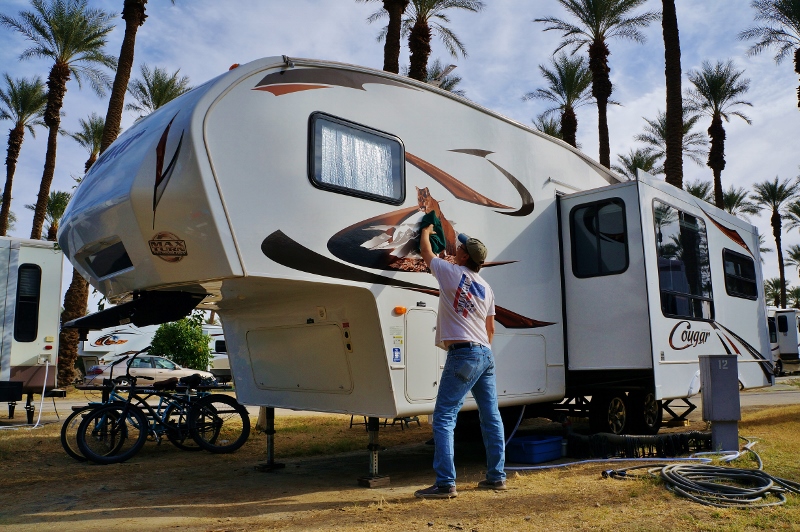
2. Ultraviolet shield
The best RV wax for fiberglass could play a role as a powerful ultraviolet shield to protect fiberglass. UV rays are notorious for their harmful effects on human and material alike, fiberglass is not an exception. Prolong exposure to UV rays will damage the fiberglass in a blink of an eye. Yet with regular application of the wax, the situation would be improved thanks to the protection it offers for the fiberglass. Waxing the fiberglass twice per year across its lifetime should be sufficient to keep the protection at an ideal level. You can either use your hand or an electric tool for the job, it’s up to you.
3. Prevent accumulation of foreign material
When you travel in the RV, dirt and debris would build up on the fiberglass roof after each day. However, with the fiberglass completely waxed, no foreign material can accumulate substantially on the surface. It’s very smooth so whatever comes into contact with the fiberglass end up sliding off instead of sticking around. The wax is effective against stubborn substances like tree sap too though it’s best to avoid it if possible.

Bestseller List
| # | Preview | Products | Our Rating | Price |
|---|---|---|---|---|
| 1 | 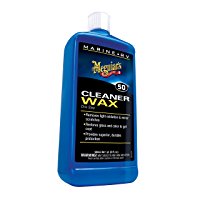 | Meguiar's M5032 Marine/RV One Step Cleaner Wax - Liquid - 32 oz | 4.6 | $$ |
| 2 |  | Meguiar's M6332 Flagship Premium Marine Wax - 32 oz | 4.8 | $$ |
| 3 | 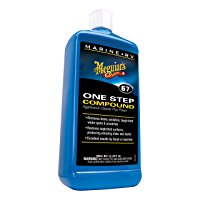 | Meguiars M6732 Marine RV One Step Compound | 4.4 | $$ |
| 4 | 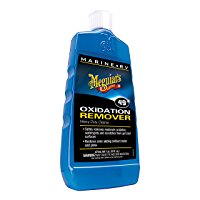 | Meguiars M4916 Marine-RV Heavy Duty Oxidation Remover | 4.3 | $ |
| 5 |  | Gel-Gloss RV Wash and Wax - 128 oz | 4.4 | $$$ |
Conclusion
And those are some of the best RV wax for fiberglass you can buy on the market, anything caught your attention yet? When you know your options clearly, the only thing left to do is to decide which suit you the most. With the help of the information above, now you should have a pretty good idea of what is a good product. If you can ensure that what you buy is able to match your preferences then it will be a wise purchase.
Related Buyer’s Guide and Reviews:
| Best RV Short Queen Mattress | >> Full Review |
| Best RV Shower Head | >> Full Review |
| Best TPMS for RV | >> Full Review |
Last Updated on January 1, 2024



Meguiar’s M6332 is worth every penny .I use it on my fiberglass motorhome exterior and after living in the hot climate. (Phoenix AZ) No fading and my coach still looks as it did new in 2012. I use this once a year by hand.
I read many of the reviews about using M5032 on RV and cars so I wanted to give it a shot. I have a jet black corvette convertible (C-5). This Auto-RV wash and wax product worked great but I found it difficult for removing the wax by hand. It is liquid and goes on quick and easy. I put it on my cool car (84 degrees but high humidity) in the garage. I waited about 15 minutes then tried to remove the dried wax with a cotton terry cloth towel. It left horrible swirls and discoloration on the car. It actually freaked me out. I moved the car into the sun for 10 minutes then went out with a clean microfiber and just rubbed and rubbed…. The end result was fantastic. The car is as slippery as ice and has a deep shine. However, if you are going to use this wax you should probably have an electric buffer.
Since this is the first time I needed to use a product to wax my RV, I found this Meguiar’s M5032 Marine product very easy to use and even easier to remove leaving a beautiful finish. No need for the power buffer with this product. Needs to be done on a cool day like any other wax product. Used 3/4 of a bottle on my 2010, 31ft 5th wheel that had never been wax before. Took the oxidation off with little effort and left it shining like new. This product is a one-step product and is great for lightly oxidized fiberglass units..
I used Gel-Gloss RV wax to wash my camper and it worked great. We had a few of those dark streaks on our camper. The camper is only two years old but we are parked under trees in a permanent site. I put some of this full strength on the dark streaks and they disappeared. My son in law was so impressed he used it on his camper.
Have been using this product for over a year and very pleased with how nice the fiberglass on my RV looks. I use this in conjunction with Meguiars Flagship Wax and Cleaner. No more searching for the perfect fiberglass wax because this stuff works great for me and is definitely the best RV wax for fiberglass I’ve used!
Gel-Gloss RV Wash and Wax really put a shine on my DP motorhome. I had previously used a very good quality and brand of car wash and wax and had thought it would be tough to improve on. I was wrong because this RV wash is superior in making the gelcoat and paint finish look great. I even used it on my dark colored suv and had great great results. Also the kids across the street thought it smelled great as I washed the RV.
My rv sat on the dealers lot for a full year, un waxed before I bought it and had oxidation on all fiberglass surfaces. I used a premium car wax on it last year and while it shined up it was clear that it would need some polish to get rid of the haze. I was hoping Meguiar’s M6332 would live up to the reviews and I have to agree with the hype. This stuff goes on a little tougher than some due to it’s quick drying but wipes off very easy. Comparing newly waxed areas to the old is night and day whether hand or machine applied. I even washed a waxed area with dish soap as a test and it dried shiny, oxidation gone. Now I’m hoping the UV protection works as claimed. A bottle this size should have some finger grips molded in for shaking and handling even with my large hands. Awkward.
Used Gel-Gloss RV wash and wax on my RV and was very pleased with how it broke down some of the dirt on fiberglass and left the RV with a nice shine. Also liked how thick the gel was and how little made a full bucket of frothy foam soap suds. Smelled good too, though highly irrelevant. Washed three vehicles and only used about 1/20th of the jug. For those who are still considering, it’s really the best RV wax for fiberglass, it won’t let you down!
Meguiar’s M5032 appears better than regular automotive/RV wax, but if you have oxidation, I would would recommend something with more abrasion. This will take off very very fine oxidation only. But its better than using regular wax if you are putting it on fiberglass. I had to use some rubbing compound too.
I have used Gel-Gloss RV wash and wax for years on trailers, fifth wheels and now a motorhome. For the past 4 years I have washed the motorhome with this product and have not waxed it at all. It looks as good as it did when new. I live in Alabama, heat and humidity is high here. I cannot say enough good things about Gel-Gloss. I use it for all vehicles including 4-wheelers. It really works!
Although Gel-Gloss RV Wash and Wax is not for a pressure washer, I did so and I was completely amazed as to how well it worked. I have a 2014 Redwood with the high gloss paint and this wash product made it look fresh out of the showroom. We have hard water problems here in Oregon but my fifth wheel air dried and there were no streaks or massive water spots. Great product. Great price.
Wow, Gel-Gloss RV Wash and Wax really made my RV which was so dull and chalky shine like new ! I’m not sure how much damage it would make look good, but I was very very happy about my outcome with this product. It seemed to wash the chalk away.
I had some hard to remove streaks and water marks on my camper that I was unable to remove. I cleaned my camper and then used Meguiar’s M5032 on it. With very little effort it removed the hard to remove black streaks and provided a protective barrier against dirt and other items. It has made future washes seem easier as the dirt wipes right off.
Gel Coat Labs Marine & Boat is a great Boat and RV wax. Easy to use and gives a beautiful shine. Wax is white so using on a white surface like on my coach makes it a little hard to see where your at when applying
I bought the Gel-Gloss soap for my travel trailer despite my wife calling me crazy for buying soap on Amazon! I’ve never seen this stuff at the store and based on the reviews I read I figured I can’t go wrong. Well I didn’t go wrong, when this runs out I’ll be buying more for sure! I bought it for my travel trailer fiberglass but I use it on my vehicles as well and it leaves a nice glossy finish that I’ve never got before with any other soaps. I’ve been washing RV for the last 15 years and this is easily the best RV wash and wax I’ve ever used.
Great reviews!.Used on Brand new 32′ Coachman Camper with fiberglass sides. I waxed early in the season, and added a 2nd coat towards the end of the summer, which was not really needed as the camper still had a great shine. Wax is easily applied and comes of with little effort. One bottle has already waxed the camper twice, and I still have a 1/4 of the bottle left. With this wax on camper you can simply wipe the black marks of the sides from the rain downspouts with a simple polishing cloth. This is also an awesome wash and wax product to used for RV fiberglass.
I read the reviews about the Gel-Gloss product and figured I’d give it a shot. My 28′ travel trailer was filthy after the winter and I hate to admit it but I hadn’t washed it after the last trip of the season. You immediately know there is something different about it when you pour a couple of ounces into the water… It looks like you poured fluorescent oil into the water. It’s so thick it does not mix. I used the brush to mix it in. It created pink water with thick lather. I used a soft brush and began washing. It cut through dirt and dried bugs like nothing I’ve ever used. No scrubbing or a lot of pressure required. Wash a section, rinse and marvel at a streak free shine. I can’t yet comment on how the wax holds up because it hasn’t been on long enough. It made the washing process pretty painless and I’d recommend it.
Waxed my fiberglass sided travel trailer with Meguiar’s M6332 which was reviewed as the best RV wax for fiberglass by many buyers on Amazon, (first time user) using an electronic applicator, tried taking if off using the same device with a removal pad but seemed to smudge. Wax came off great by hand though, giving the rv a better than new shine. Would highly recommend this product!
Yeah. Meguiar’s M5032 is an excellent product..worked well on my motor homes fiberglass body. Removed minor scratches and dullness , leaving a well polished shine. Restores a dull finish well..Use their one step compound on areas that are heavily chalky or faded. Best RV wash and wax product I’ve used so far!
Thanks Carlos for very informative review about best RV wash and wax products. My 1978 RV needed a little TLC so I bought Gel Coat Labs Marine. It is a great product and worth the money. I would highly recommend buying an inexpensive buffer (I bought one at local walmart for about $20). It made the buffing process much easier. If you feel like getting a good workout then do it by hand. Looks beautiful either way. Highly recommend this product.
I use Meguiar’s M5032 wax on my boat so, I thought I would try it on my RV. This is one very durable wax. After several months with my RV in an area with soil ladden with salt, the wax is still holding up well. The water still beads up on the surface. Good stuff.
First off, let me start this with I AM A LAZY F#$%#. I will forego doing something so I can do nothing (can’t we all?). However, I do value my trailer and I do prefer it to look like I care. I bought an extension brush (soft style) and this Gel-Gloss product. I mixed about a half to three quarters cup amount into a 5gal bucket filled 3/4 way. This jug o’ stuff is super thick, so it needed a good stir to dissolve into the bucket. I rinsed a section of the coach to remove/loosen any dirt. Then, I dunked the brush and quickly slathered the cleaner on the wet section, scrubbing lightly. The black marks disappeared with exceptional ease. Better than I’d experienced with using Dawn. The shine left behind is minimal, of course, but is there. If it gives the coach any level of protection, it’s a win in my book.
I know Meguiar’s already has an outstanding reputation, but I felt compelled to reinforce that by leaving a review. I used Meguiar’s M6332 on a fiberglass boat that had pretty significant fading due to sun exposure. After just one coat and minimal polishing, the color came back to life and my hull is looking like new. After seeing the results on the boat, I used this product on a painted aluminum sided travel trailer and RV fiberglass. Again, it brought the color to life. I’m a fan and will be a repeat customer.
Have used a number of similar products and Gel-Gloss is the best RV wax for fiberglass I think. Lathers up really well and made our RV shine nicely. Mixed in bucket and applied with brush. Grime from winter storage came off easily and quick rinse left a nice glossy finish. I waxed afterwards also to build up good protective layer for the season but didn’t have to to get a nice shine.
M6332 is a great wax goes on easy makes fiberglass shine nicely, get some if you have an RV you want to brighten up works well and does not harm decals either. I would really say that it deserves to be the best RV wax for fiberglass!
Was looking for a simple and reasonably priced one step product for our gel-coat camper. Very pleased with the ease Gel-Gloss RV wax cleaned with a car wash mitt, sprayed it off, and the shine came back immediately. The decal colors also returned. A minor amount of wax flaking could be seen on the black decals the following day but easily wiped off with a microfiber. Used less than 1/4 bottle, 29 ft camper. Recommend it
I hadn’t washed my fiberglass Starcraft Aruba in over a year. I purchased Gel-Gloss RV wash and wax based on reviews (was only looking for a new RV brush). On wash day, I grabbed a couple of bottles of black streak remover I had laying around as part of my usual regimen. Didn’t need them. This stuff worked great without having to scrub, be it dirt, black streaks, or green algae. Simply suds on and rinse off. Unlike with the black streak remover, there were no color run-offs from the side decals either. Washing the entire 28′ camper only took about 2-3 oz., and it was much quicker than usual. It didn’t do much for the stains on the awning–which is what I expected since nothing has really helped that. This is the best RV wax for fiberglass for the price. I plan on using this on my vehicles too–just haven’t tried it yet. Bonus: It kind of smells like Twizzlers (if you like that)
Thanks for such useful reviews. I have a full body paint 40 RV, which I store in the southern California sun every day. The M5032 product Meguiar’s from keeps it looking new every day.
This Gel-Gloss wax is AMAZING!!!!! I have used another branded RV wash & wax before this one on my RV and it was good and I was satisfied with it. But Amazon didnt have it anymore. I read the reviews on this one on your post and it was more expensive than the previous brand I used but everyone seemed very happy with this one so I bought it. I washed my trailer with it using about twice the recommended amount of the wash-to-water ratio. And it was amazing! It washed the trailer better than i expected! And as other reviewers stated, you dont have to dry the trailer after washing it to make sure it isnt spotty with water spots once they dry. I still dried it with towels though because it allows me to spot check all over the trailer more closely. It left behind that nice waxy feeling of a good hand wax and it left a beautiful sheen to the trailer! Other reviewers here also posted more than positive results when using this was on their automobiles. I thought I would give it a try. AMAZING!!!! The best RV wash and wax product! It washed better than normal auto detergents and again you dont have to dry it because it leaves almost no water spots behind. (Notice I said almost no water spots, so I still hand dried it). Again, it left an amazing sheeny shine and waxed feeling to the car. I will definitely be using this to wash my vehicles as well from now on!
Super product from Gel-Gloss. Cleans and shines your RV, SUV, or car or Truck like a dream. I used it on my RV and my SUV. With other wash/wax combos I would have to put in some extra cleaning time to get it cleaned. Not with Gel-Gloss. 2 weeks ago I washed my RV and SUV. The RV wasn’t very dirty but after I was done it shined and looked great. MY SUV was filthy, very dirty. I just did a quick wash because I was tired from washing a 35′ camper. The SUV I washed with an extended brush and it turned out AMAZING with little effort! I did not expect it. The best results I have ever received using a wash/wax combo. Removed the dirt beautifully. I HIGHLY recommended this product. Price is great on AMAZON as well!
Application was pretty easy to my 35 ft fifth wheel and friend’s 38 ft motorhome. I used a buffer to apply in most areas and a terry rag in difficult spots. Removed with a microfiber towel. Nice shine. First wax job on both units so time will tell longevity. I did find that Meguiar’s M6332 wax is VERY temperature sensitive as the label instructs. I started to wax a section on my RV that was in direct sun with outside temperature in the low 70’s and it dried too fast. I moved to a shaded area and worked great. Also on my friend’s MH it was a day in the low 50’s and late in the day a wind picked up dropping the temp and we found that the wax did not apply nor remove properly.
Purchased Meguiar’s M5032 as your recommendation to put a nice coat of wax on my 2004 RV camper. It was hard work but the outcome was great. I used a small electric buffer on small areas of the unit and a regular buffer on the larger areas. Was very pleased with the results. Like I stated before it was a lot of work but the dealers charge any where from $200 to $400 to wax a camper. Probably more on a larger rig. My unit was a 30 feet Class C rig. Would use this product again. This would be the best RV wash and wax product which made the RV shine like it was new…….Very happy with results.
I bought a 9 year old camper. It had some dark spots on it and it had some scuff marks from where the old owner had a cover on the camper. Washing it took some of the spots off and lightened the scuffs, but didn’t remove them. The Meguiar’s M5032 wax did a great job of removing the marks, and it left the camper with a nice shiny finish. I was using a power buffer to put it on and take it off. I had to use the hand applier for corners and tight spots. And I used the hand applier for some of the darker spots… it took them off better. So – if you have a camper that you can’t get clean buy some of this stuff and it will fix it up! In my opinion, it’s also the best RV wax for fiberglass that you should give a try! Worth every penny I assume.
I used Meguiar’s M5032 for the first time yesterday on our 36 feet long class A NEWMAR MOUNTAIN AIR RV after buying it on Amazon (I read your review and decided to try it on my RV) and I was pleasantly surprised. I was able to wax the whole vehicle with just about a half gallon and no effort. It cleaned it perfectly and revived the paint leaving a really nice and glossy shine and a protective coat of clear wax. The product is the best RV wax for fiberglass and worth the price. I will definitely buy it again and will give it a try in our cars
Started waxing Meguiar’s M6332 for my 2 year old motorhome with very good results compared to auto wax.
Gel-Gloss RV Wash and Wax did a fantastic job cleaning a very dirty, neglected camper which we had purchased used. Everyone thought we had purchased a new camper when they saw it after it was washed. It didn’t restore the shine of the fiberglass to the glossiness I was hoping for but I’m not sure much of the original wax is still remaining. Overall we were extremely pleased with the product and would really think it is the best RV wax for fiberglass we used for mine. We also used it on our vehicles and it worked well for them too. It also has a great scent. We didn’t need this large of a container. The product is very thick and concentrated. A little goes a long way. This will be a lifetime supply for us.
Meguires is fantastic! We left our RV in Yuma, AZ for summer and the amount of rust was very surprising. Our motorhome looked like it had aged 10 years. We’re proud of all of our vehicles, so I looked at how we could make our RV look Decent again. Meguire’s products got high marks so I bought them and our motorhome actually looked like new again. I won’t lie, it took a lot of muscle to get rid of rust and we had to buy a new shock, but the results were worth it. Our entire RV travel club has now bought it for their platforms too.